The Disappearance of the Salford Tank
Salford Royal Hospital | Jess Hardman Watson, University of Salford
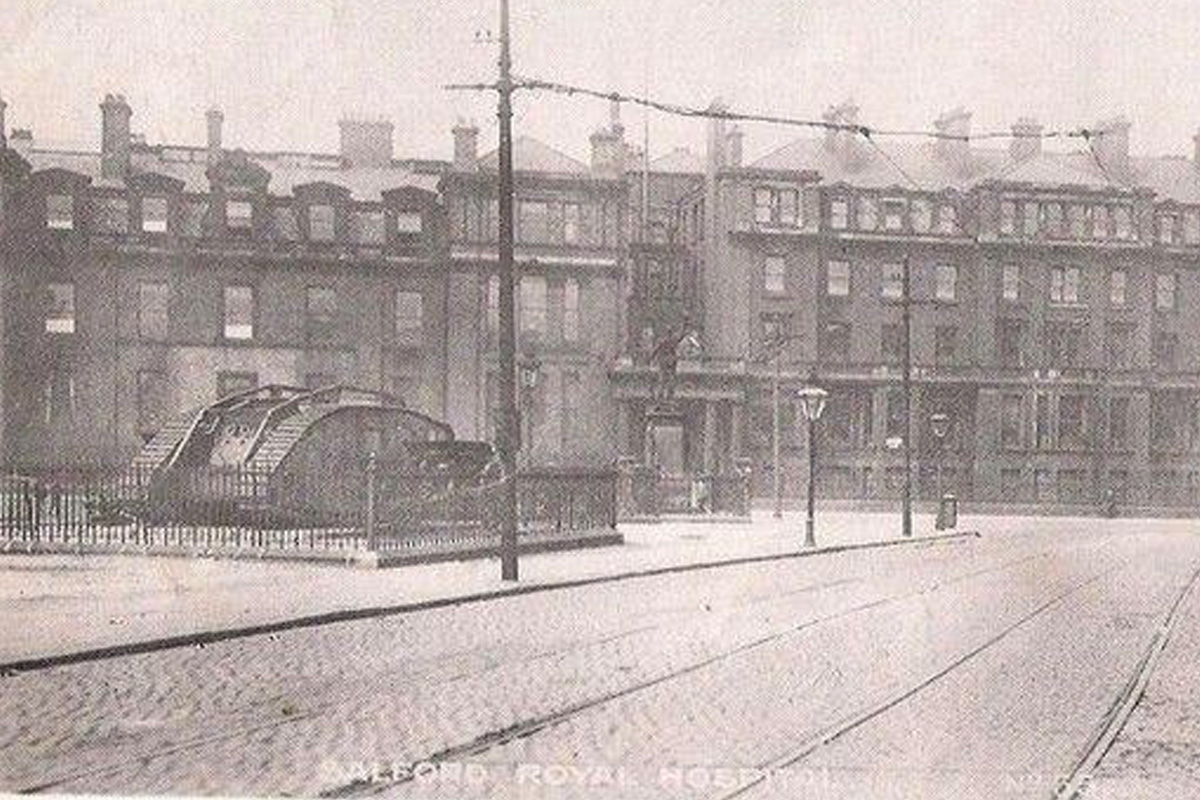
Postcard: Gray, Edward, Greetings from Old Salford, Printwise Publications Limited, 1991.
Want to listen instead? Click below.
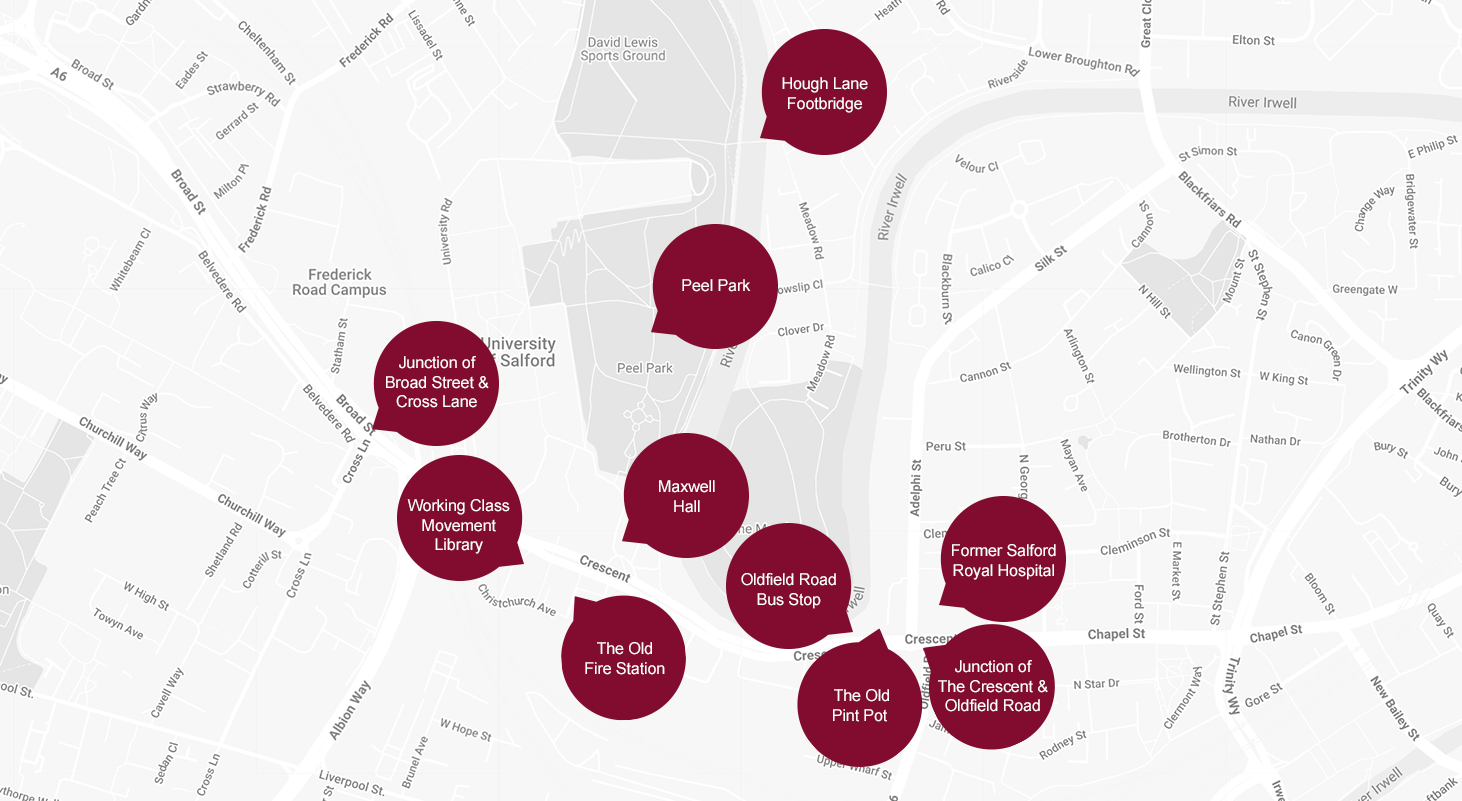
Three sources trace the short but revealing history of a First World War tank monument that once stood near the junction of Chapel Street and Oldfield Road, installed in the aftermath of the war as a symbol of civic pride. The tank was later removed as attitudes toward wartime trophies changed. Together, these images help illustrate how the area surrounding Salford Crescent has been shaped not only by transport and urban development but also by shifting ways of remembering the First World War.
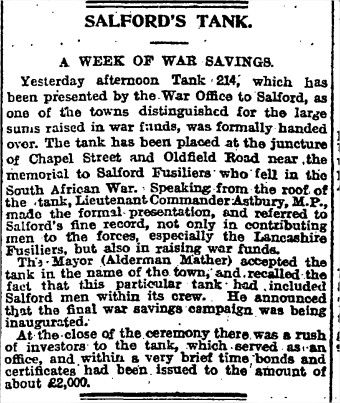
“SALFORD’S TANK: A WEEK OF WAR SAVINGS.” The Manchester Guardian (1901-1959), May 20, 1919, Page 12.
The newspaper article “Salford’s Tank: A Week of War Savings,” published in The Manchester Guardian on 20 May 1919, explains how the tank first came to Salford. Tank 214 had been presented to the town by the War Office in recognition of the large sums raised locally through War Savings campaigns.
Such presentations were common across Britain after the war, with captured or decommissioned military equipment awarded to towns that had demonstrated strong financial support for the national war effort. In Salford, the tank was placed prominently near the entrance to Salford Royal Hospital, ensuring that it would be seen daily by residents travelling along Chapel Street and Oldfield Road. At the time, the monument symbolised both victory and civic contribution, linking Salford’s wartime fundraising to the service of local soldiers, including men from the Salford Fusiliers.
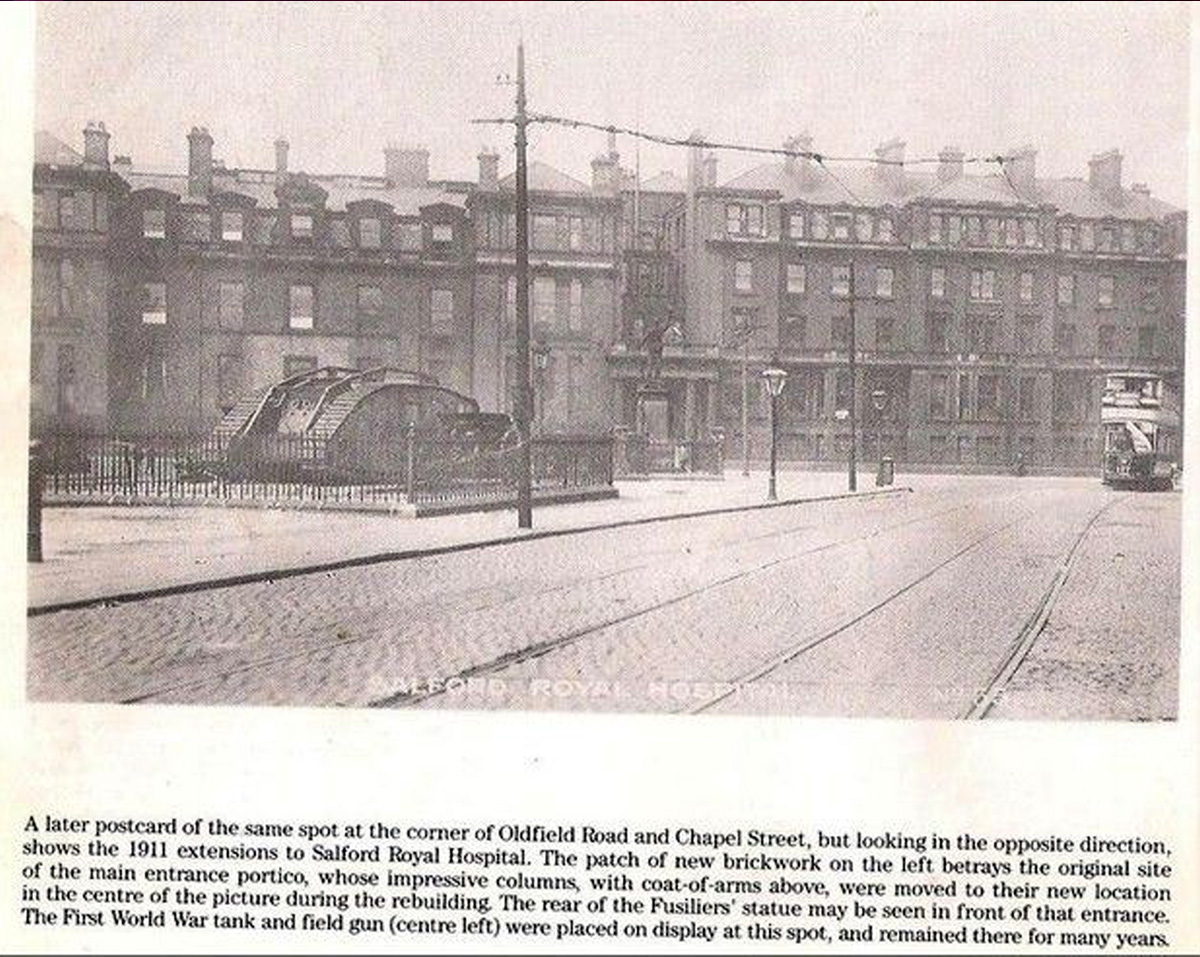
The postcard image reproduced in Edward Gray’s Greetings from Old Salford (1991) visually captures this moment in the city’s history. The photograph shows the tank and accompanying field gun positioned outside the hospital railings, surrounded by tram tracks, terraced housing, and busy streets. The military hardware stands in stark contrast to the ordinary urban environment around it. For several years after the war, the tank functioned as a public landmark and a physical reminder of Salford’s participation in the conflict.
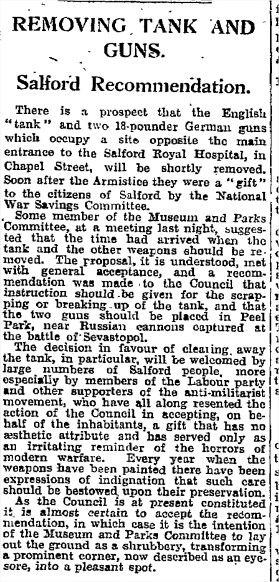
“REMOVING TANK AND GUNS: SALFORD RECOMMENDATION.” The Manchester Guardian (1901-1959), Apr 27, 1927, Page 14,
However, the third source reveals how quickly public opinion began to change. In the article “Removing Tank and Guns: Salford Recommendation,” published in The Manchester Guardian on 27 April 1927, local authorities discussed plans to remove the tank and artillery pieces from their prominent location. By the mid-1920s, these wartime trophies were increasingly seen as inappropriate for public display. The article describes how many residents regarded them as “distressing reminders” of modern warfare rather than symbols of victory. Their presence also raised concerns about the appearance of the area, as the large military objects dominated an important civic junction.
The proposed removal reflected broader interwar trends across Britain. In the immediate aftermath of the First World War, captured weapons and tanks were often displayed proudly in public spaces. Yet within a decade, communities began reconsidering these displays. As memories of the war’s human cost deepened, many towns chose to remove or relocate such objects, favouring more reflective forms of remembrance such as stone memorials or landscaped public spaces.
In Salford, the decision to remove the tank helped reshape the character of the junction near Salford Crescent. The site gradually shifted away from its role as a display space for military trophies and became part of the evolving urban landscape of the city. As Salford Crescent celebrates its centenary in 2026, these sources remind us that the area’s history is not only about transport and growth, but also about how local communities have chosen to remember and sometimes reconsider the legacy of war.
PHOTO CREDIT: As Above
Explore the rest of the trail…